
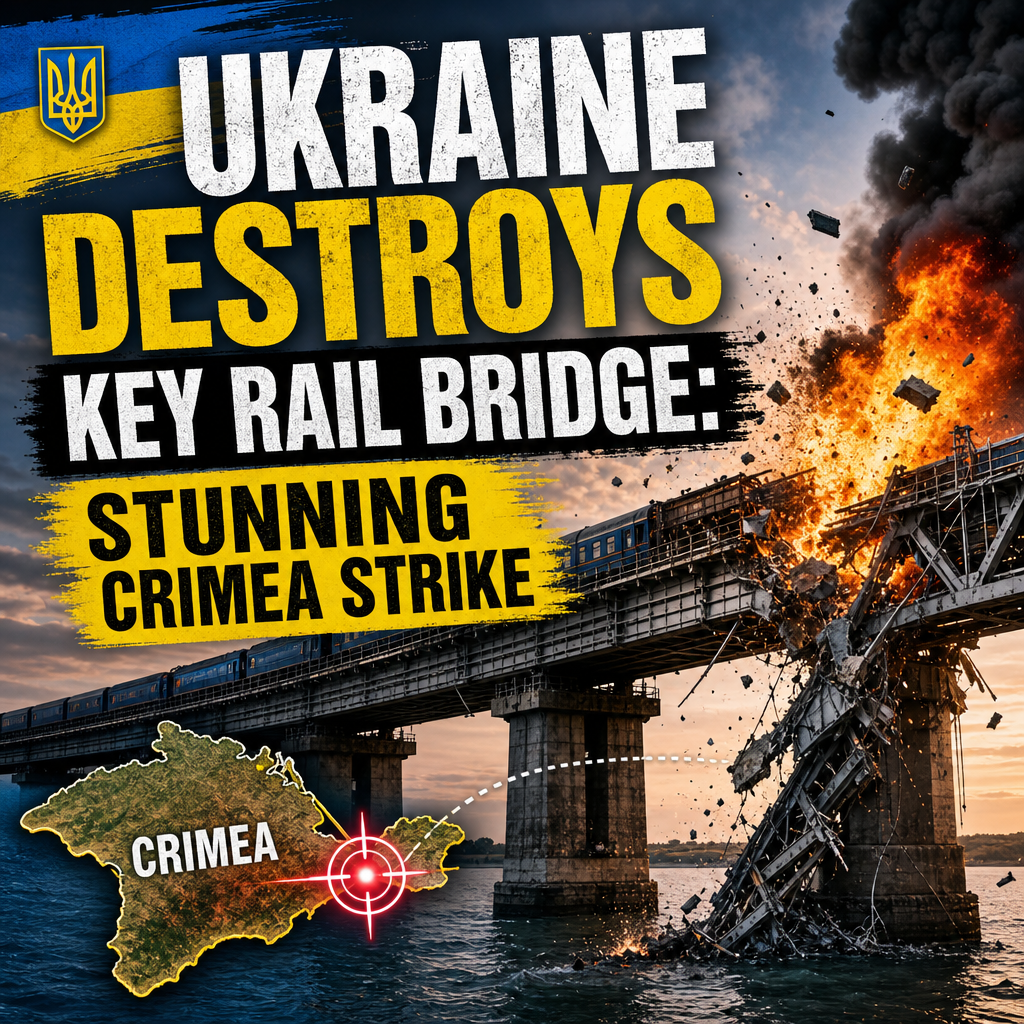
Ukraine Destroys Key Rail Bridge: Stunning Crimea Strike


Ukraine destroys key rail bridge in Crimea, and the strike has quickly become more than a battlefield headline: it is a reminder that the war’s most consequential moves are increasingly about logistics, signaling, and psychological pressure as much as territory. According to reporting from Sky News and broader coverage in international outlets, the attack is being framed in Kyiv as part of a campaign to complicate Russia’s supply lines into occupied Crimea, while Moscow and pro-Russian media have pushed back by downplaying damage, emphasizing resilience, or portraying the assault as another example of Ukrainian escalation.
What makes this episode notable is not just the bridge itself, but the strategic meaning attached to it. Rail links matter enormously in this war because heavy equipment, fuel, ammunition, and personnel move far more efficiently by rail than by road. If a key bridge is damaged, even temporarily, it can force detours, slow deliveries, and expose other routes to additional risk. That is especially important in Crimea, which Russia has used as a military hub since its annexation in 2014 and as a staging ground after the full-scale invasion of Ukraine.



Why the Crimea rail bridge matters
From a military perspective, rail infrastructure is one of the most vulnerable and valuable targets in a long war. A bridge is not simply a piece of concrete or steel; it is a bottleneck. If it goes down, the effect can ripple across an entire regional network.
In this case, the reported target fits a wider pattern seen throughout the conflict:




– Ukraine has repeatedly targeted supply lines, ammunition depots, and transport corridors.
– Russia has relied on Crimea as a logistics and command center for operations in southern Ukraine.
– Each successful strike raises questions about how secure Russian rear areas really are.
Sky’s coverage presents the attack as part of a fresh wave of Ukrainian pressure designed to isolate Crimea. That framing is significant because “isolation” in military terms does not necessarily mean total severance. It can mean making movement slower, riskier, and more expensive, which can gradually erode battlefield momentum. Even limited disruptions can force Russia to divert resources to repair work, air defense, and route protection.
At the same time, it is important to be careful about the evidence. In wartime, both sides have strong incentives to shape the story before independent verification arrives. Kyiv may want to demonstrate reach and initiative. Moscow may want to minimize the damage to preserve an image of control. That tension makes outside reporting especially valuable, but also means some claims may remain provisional until clearer imagery or technical assessments emerge.
Ukraine Destroys Key Rail Bridge: what the reaction reveals
The reaction to the attack tells its own story. Ukrainian officials and media supporters tend to present such strikes as operationally justified and strategically smart, especially when they hit infrastructure linked to Russian military use. They argue that Crimea is not a passive rear area but an active military platform, and that disrupting transport there directly affects Russia’s ability to wage war.
Russian outlets and state-linked voices, including those in the RT ecosystem, typically emphasize a very different narrative. They are likely to stress that defenses remain intact, repairs can be made quickly, and Ukrainian attacks are proof of desperation rather than strength. That framing aims to reassure audiences inside Russia and Russian-held areas that the situation is under control.
Al Jazeera’s broader regional reporting often places these kinds of events into a wider context: not just military gains and losses, but the humanitarian and diplomatic consequences of escalation. From that angle, a bridge strike is not only about battlefield advantage. It also signals that neither side sees pressure on occupied territory as off-limits, which can complicate any near-term hope for de-escalation.
The divergence among the sources is instructive. There is no real consensus on the exact scale of the damage, but there is a clear consensus on the significance of the target. Everyone involved understands that rail links are critical. The disagreement is over whether this strike meaningfully changes the strategic picture or merely adds another temporary disruption to a war already defined by such blows.
What this could mean for Crimea and the war
If the bridge damage is substantial, the consequences could include:
– slower movement of military supplies into and out of Crimea
– increased pressure on alternative transport routes
– more Russian resources diverted to repair and security
– greater political and symbolic emphasis on Crimea as a vulnerable front
If, however, the damage is limited or quickly repaired, the strike still matters for another reason: it demonstrates reach. In a war where perception can shape policy, the ability to hit a sensitive target may be almost as important as the physical result.
That is why analysts often caution against reading one strike as decisive on its own. Infrastructure attacks are cumulative. One damaged bridge may not change the war overnight, but repeated hits can create a steady drag on logistics, morale, and planning. Over time, that can have real operational effects.
The bigger picture
The broader lesson from this incident is that the war remains fluid, and both sides are still trying to prove they can impose costs far from the main front lines. Ukraine is showing that occupied Crimea is not beyond reach. Russia is trying to show that such attacks will not alter its hold on the peninsula. International observers are left weighing claims, counterclaims, and incomplete evidence while trying to separate tactical disruption from strategic change.
The most balanced conclusion is probably this: the strike is important, but not necessarily decisive. It underscores Crimea’s vulnerability, highlights the continuing importance of infrastructure warfare, and reinforces how much the conflict depends on logistics rather than headlines alone. Whether the bridge becomes a turning point or just another damaged link will depend on what happens next—repairs, follow-up strikes, and the broader tempo of the war.